
Fracture
PREREQUISITES
- Continuum Mechanics
- Linear Elasticity
COURSE CONTENT
This course consists of a theoretical part introducing the fundamental concepts of fracture mechanics and experimental laboratory sessions.
THEORETICAL PART
This part deals with the fracture of components subjected to mechanical loading, with a particular focus on crack propagation. After a general introduction to the causes of brittle and ductile fracture, the course presents the fundamentals of linear elastic fracture mechanics.
The first part of the course focuses on the strain and stress fields at the crack tip following Williams’ approach. The stress intensity factors (SIFs) are introduced, together with their physical interpretation with respect to crack loading conditions. The relationship between SIFs and fracture in Modes I, II, and III is established and related to the phenomenon of crack branching. Finally, Irwin’s criterion for Mode I fracture and fracture toughness are introduced. This criterion is then used to assess the risk of crack initiation in practical engineering applications.
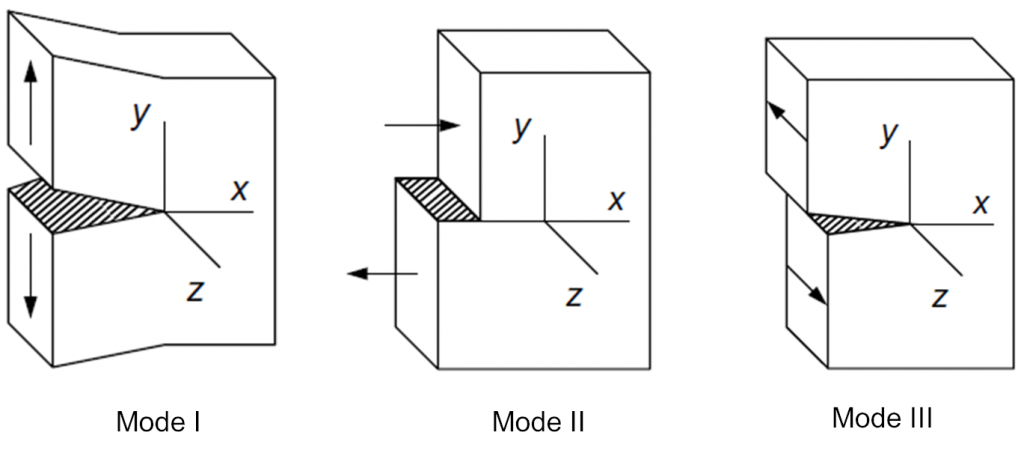
Next, the practical determination of stress intensity factors is addressed. First, existing analytical solutions derived from Westergaard’s approach are presented. Then, numerical methods are introduced, including the implementation of cracked numerical models and the evaluation of SIFs using methods such as the Displacement Extrapolation Method (DEM) and the computation of the Rice J-integral. Practical post-processing exercises based on these analytical and numerical methods are carried out to evaluate their accuracy as a function of mesh parameters.
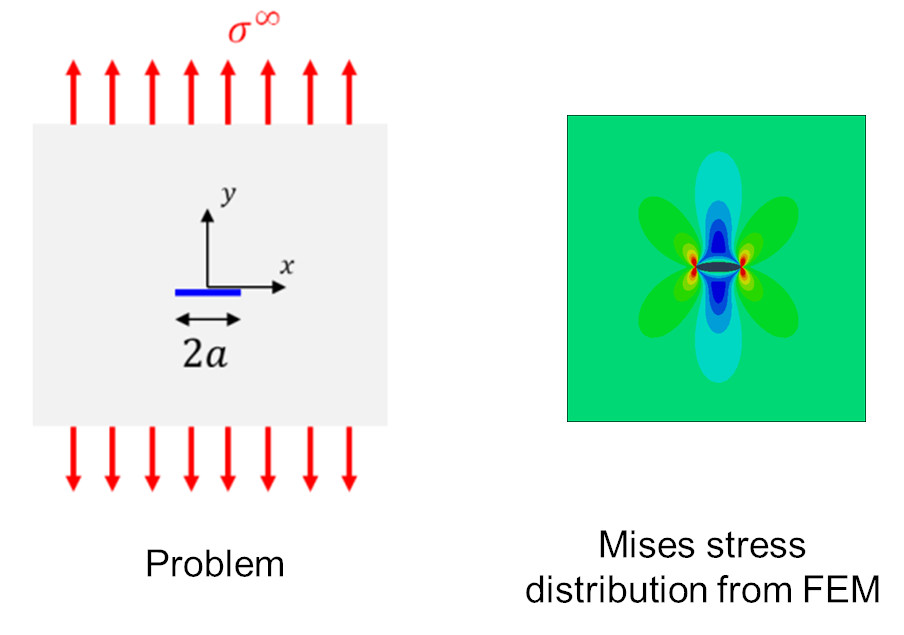
Finally, the derivation of fracture criteria is discussed following Griffith’s approach. The concept of the energy release rate is introduced together with its critical value. The stability criterion for crack propagation is then established. Finally, the relationship between this approach and stress intensity factors is discussed.